

Palaces of Buenos Aires, a tour of the most outstanding buildings in the city of Buenos Aires.
At the beginning of the SXX, Buenos Aires was one of the richest places in the world. At that time, the city was undergoing great urban changes, shaped by French fashion in urban planning and architecture. As a result, many of the families of the Buenos Aires aristocracy decided to renew themselves. So, they moved to the north of the city, in the Retiro, Recoleta and Palermo neighborhoods, where they built their new houses. In the end, they created a great collection of majestic palaces, whose architectural legacy still embellishes the streets of Buenos Aires today.
Here we leave you the best Palaces of Buenos Aires:
SAN MARTIN PALACE
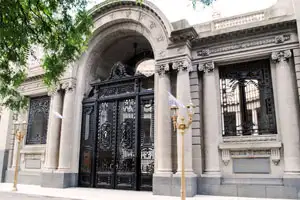 The San Martín Palace is, today, the headquarters of the Argentine Chancellery. Originally, though, it was the great house of the Anchorena family. Architect Alejandro Cristophersen designed it for Mrs. María Mercedes Castellanos de Anchorena. Specifically, it features a large pointed reception with two staircases of honor that lead to the raised upper floor, or “piano nobile”. Its façade, meanwhile, follows the guidelines of the Beaux Arts school in Paris. In 1936, the Argentine Foreign Ministry bought the building and named it “Palacio San Martín”, giving it the function of Headquarters of Argentine Diplomacy.
In our Free Tour Recoleta you will find this beautiful Palace, touring this picturesque neighborhood of Buenos Aires!
PAZ PALACE
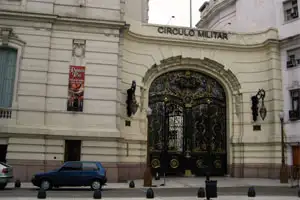 It is the largest Palace in Buenos Aires with 12 thousand square meters. It was the home of José Camilo Paz, founder of the newspaper La Prensa. Its façade, for instance, reminds us of a fortified French Chateau, with high walls and elegant crowns. Its main door, meanwhile, is one of the great jewels of Buenos Aires. Through it, we access the large round room that today remains intact and still dazzles all its visitors. Today, the Military Circle owns the Palace, and visitors can tour it by appointment.
Here we leave your website for more information.
ORTIZ BASUALDO PALACE
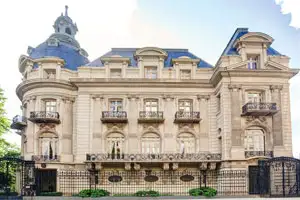 It is the most refined Palace in Buenos Aires. Its large dome with a lamp crowns the end of Avenida Alvear on the edge of Recoleta and Retiro. Specifically, the Ortiz Basualdo family built the house, and the Maison Jansen of Paris, the most famous decoration house in history, decorated it. There, the Prince of Wales Edward VIII stayed on his visit to Argentina. In 1939, the French state bought the property to serve as an embassy. In the 70s, city planners sought to demolish it to build the Illia highway, but the French state opposed the expropriation. So, it survived, and we can still see it today.
PEREDA PALACE
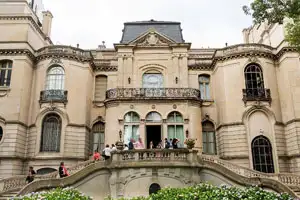 Today it is the Embassy of Brazil. It was originally the home of Celedonio Pereda, who commissioned a palace with a facade inspired by the National Museum of France in Paris. The great Catalan painter José María Sert, meanwhile, painted its ceilings. In the 1930s, the President of Brazil Getulio Vargas stayed there. That’s why, in 1945, after Pereda’s death, the Brazilian State bought it to serve as an embassy.
ALZAGA UNZUE PALACE
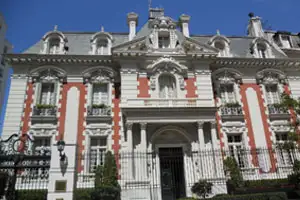 This elegant mansion was the house that Félix Saturnino de Álzaga and Elena Peña Unzué bought after getting married. Today, it is the La Mansión Suite of the Four Seasons Hotel, one of the most luxurious places in Buenos Aires and where various celebrities such as Madonna and the Rolling Stones have stayed. So, you can enjoy it by attending the hotel restaurant.
FERNANDEZ ANCHORENA PALACE
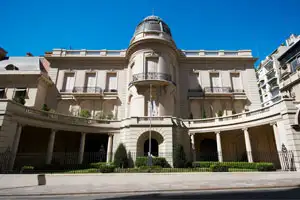 It is currently the Apostolic Nunciature, the Vatican Embassy. There, Adelia Harilaos de Olmos lived, one of the most outstanding women in the history of Buenos Aires. Indeed, she served as president of the Society of Charity, carrying out a great charitable and philanthropic work throughout the country. Also very close to the church, she organized the Eucharistic Congress in 1934 and earned the title of pontifical marchioness. When she died, she donated her house to the church. Today, it is the Nunciature, where Pope John Paul II stayed on his visit to Argentina.
This immense palace is part of our Free Tour Recoleta.
DUHAU PALACE
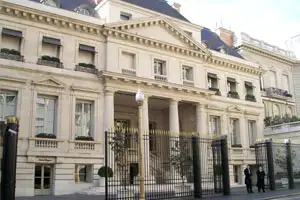 This beautiful and solemn mansion belonged to Luis Duhau, Minister of Agriculture. Today, it operates as part of the Park Hyatt Hotel. Specifically, the hotel consists of a historic building and a modern one on the other side, down the ravine. Between both buildings, meanwhile, there is a beautiful terraced park where you can enjoy a luxury restaurant.
You will find this Palace in our Free Tour Recoleta!
MAGUIRE RESIDENCE
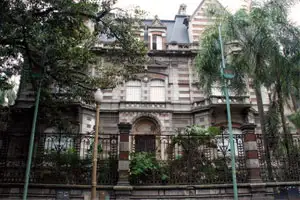 This beautiful mansion dazzles all who walk along Avenida Alvear. Its style is very contrasting, with the exposed brick and the large bars worked with the best iron craftsmanship, making it more British than other Buenos Aires palaces. It was the home of Alexander Hume, a Scottish railway entrepreneur, and the Duhau family later bought it. Today, it is still a private residence.
You will find this mansion in our Free Tour Recoleta.
ERRAZURIZ PALACE
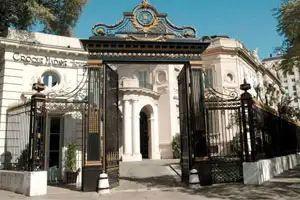 It is one of the largest and most dazzling palaces in the city, and, in addition, you can easily visit it. Specifically, French architect Rene Sergent built it for the Chilean diplomat Matías Errazuriz and his wife Josefina de Alvear. Since 1944, it has housed the Museum of Decorative Art, so it’s open to the public. There, you will see different rooms with different decorative styles, from neo medieval to baroque and even Art Deco. It truly deserves a visit!
Here we leave your website for more information.
BOSCH PALACE
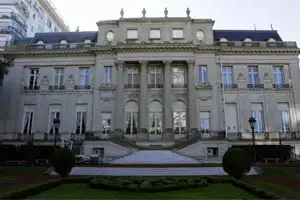 The Bosch family home is, today, the United States Embassy. Specifically, Ambassador Robert Bliss bought it from Ernesto Bosch, who was Chancellor of the Argentine government. Architect Rene Sergent designed it, together with Carlos Thays’ gardens, and several presidents of the United States, such as Roosevelt, Eisenhower, Bush and Obama, stayed there.
BONUS TRACK
Buenos Aires still has many more Palaces to discover. Some are a little smaller or lesser known, but here are a few: Acevedo Palace (Saudi Arabian Embassy), Leloir Palace (Italian circle) and, outside the city, the Victoria Ocampo House.